
For businesses that depend on weighing as part of shipping, inventory management, order fulfillment, and material handling, the scale is more than a device that displays a number. It can be a critical checkpoint in the workflow. An inaccurate shipment weight can affect freight charges, while inefficient parts counting can turn inventory work into a surprisingly effective way to make an eight-hour shift feel like twelve.
Fairbanks Scales brings a remarkably long history to those weighing challenges. The company has provided industrial weighing equipment for more than 180 years and continues to develop weighing equipment and systems designed around the needs of commercial and industrial customers.
The Fairbanks selection available through Hogentogler is focused on two practical categories: Fairbanks Shipping Scales and Fairbanks Counting Scales. While both perform accurate weighing, they solve distinctly different workflow problems.
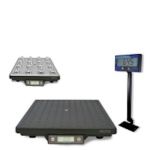
Shipping scales are designed to make package weighing fast, repeatable, and easy to integrate into everyday fulfillment operations. They are particularly useful anywhere outgoing packages need to be weighed before carrier pickup, shipping labels are generated, or freight and postage charges are calculated.
Typical users include warehouses, distribution centers, manufacturing facilities, mailrooms, fulfillment operations, receiving departments, and businesses with dedicated packing and shipping stations. For organizations processing a steady stream of parcels, having a scale positioned directly within the shipping workflow can eliminate unnecessary handling and help employees move orders out the door more efficiently.
Fairbanks shipping scales are well suited to these environments because the basic platform-scale configuration allows cartons and packages to be placed directly on the weighing surface. Depending on the application, a shipping scale may be used alongside a computer, shipping software, label printer, or other order-processing equipment to help create a more streamlined packing station.
Capacity and platform dimensions deserve particular attention when selecting a shipping scale. A scale needs enough capacity for the heaviest packages being processed, but the physical size of those packages matters as well. Oversized cartons can obscure a display or become awkward to position on a platform that is technically capable of supporting their weight but too small for practical use.
Buyers should also consider readability, connectivity requirements, available workspace, power options, durability, and how frequently the scale will be used. A scale used occasionally in an office mailroom faces a very different workload from one processing hundreds of cartons per day in a distribution facility.
Hogentogler's Fairbanks page currently identifies four different shipping scale models, providing options for businesses looking to incorporate Fairbanks weighing equipment into their parcel and fulfillment operations.
Shipping is one of those applications where a scale can quietly affect productivity all day long. We like Fairbanks shipping scales because they bring the company's industrial weighing heritage to an everyday business task where speed, reliability, and straightforward operation matter. They are an especially logical fit for busy shipping stations where package weighing needs to become a seamless part of the process rather than an extra step.
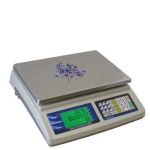
Counting scales take weighing one step further. Instead of simply determining the total weight of a group of items, a counting scale uses the weight of a known sample to calculate how many individual pieces are present.
That capability can dramatically speed up jobs involving large quantities of identical or substantially uniform parts. Rather than manually counting hundreds or thousands of washers, fasteners, electronic components, hardware pieces, molded parts, packaging components, or other small items, an operator can establish an average piece weight and allow the scale to calculate the quantity.
The basic principle is straightforward: establish the weight of an individual piece or representative sample, place the larger quantity on the scale, and use the measured weight to determine the total piece count. The result can turn an otherwise tedious manual task into a much faster weighing operation.
This makes Fairbanks counting scales useful across manufacturing plants, stockrooms, warehouses, assembly operations, distribution centers, hardware suppliers, maintenance departments, and inventory-control environments. They can be used when receiving bulk components, issuing parts to production, checking quantities before shipment, packaging products into predetermined counts, or performing physical inventory.
Accurate piece counting does require some thought about the items being measured. If nominally identical components vary significantly in individual weight, the accuracy of the calculated count can be affected. Establishing a representative sample is therefore an important part of good counting-scale practice, particularly when working with very lightweight components or large quantities.
Capacity, readability, minimum piece weight, platform dimensions, sample size, user interface, and workflow requirements should all factor into the selection of a counting scale. The best choice isn't necessarily the model with the highest capacity; it is the scale whose weighing performance fits the size and weight of the parts being counted.
Manual counting has its place. Counting 4,000 identical fasteners one by one is not that place.
We like Fairbanks counting scales because they use precision weighing to solve a practical productivity problem. For businesses routinely receiving, stocking, packaging, or distributing large quantities of small components, a dedicated counting scale can help reduce repetitive manual work while providing a more efficient method for inventory and quantity verification.
The Fairbanks brand selection on Hogentogler is organized into two categories: Fairbanks Shipping Scales and Fairbanks Counting Scales. The shipping scale category currently identifies four different models.
Shipping scales are used to determine the weight of packages and parcels for shipping, fulfillment, receiving, and logistics applications. They are commonly used in warehouses, distribution centers, mailrooms, manufacturing facilities, packing stations, and other businesses that regularly prepare packages for shipment.
Start with the maximum and minimum package weights you expect to handle, then consider platform dimensions. Readability, durability, connectivity, display visibility, available workspace, and compatibility with the rest of your shipping workflow may also be important.
A counting scale determines the quantity of similar items by comparing their total weight with an established average piece weight. Instead of manually counting every component, the operator can weigh the group and allow the scale to calculate the number of pieces.
Counting scales are commonly used for fasteners, washers, nuts, bolts, electronic components, molded pieces, hardware, manufacturing components, packaging items, and many other relatively uniform parts. The scale and required readability should be selected according to the weight of the individual pieces and the total quantities being handled.
They can be, provided the scale has sufficient resolution for the individual piece weight and an appropriate sample is established. When individual pieces are extremely light, small differences in component weight become increasingly important. Selecting a scale with suitable readability is critical for reliable counting performance.
Both instruments measure weight, but they are optimized for different jobs. A shipping scale is primarily intended to obtain package weights efficiently, while a counting scale includes functionality for translating weight into piece quantities. If inventory counting is a routine part of the application, a dedicated counting scale is generally the better choice.
Fairbanks scales are appropriate for commercial and industrial environments such as warehouses, manufacturing plants, distribution centers, shipping departments, fulfillment operations, stockrooms, receiving areas, and inventory-control departments.
Few weighing-equipment companies get to measure their history in centuries.
Fairbanks has been supplying industrial weighing equipment for more than 180 years, giving the company a depth of experience that predates just about every modern technology now connected to a scale. Throughout that history, Fairbanks has continued developing scale designs and weighing systems while supporting customers through Fairbanks sales and service representatives and authorized distributors.
That heritage makes sense in the two Fairbanks categories offered through Hogentogler. Shipping and counting aren't exotic weighing applications, but they are enormously important ones. Warehouses need accurate package weights. Manufacturers need reliable component counts. Distribution operations need both, often hundreds of times in a single day.
Fairbanks shipping scales address the movement of products out of an operation, while Fairbanks counting scales help businesses understand and control what's moving within it. Together, they support two fundamental industrial workflows: knowing how much something weighs and knowing how many of something you have.
For warehouses, manufacturers, fulfillment operations, distribution centers, stockrooms, shipping departments, and other businesses looking for established industrial weighing technology, Fairbanks brings more than 180 years of scale experience to the job.