
High-temperature laboratory work leaves little room for "close enough." Whether a furnace is being used for heat treatment, materials research, sample preparation, ceramics, or controlled-atmosphere processing, maintaining predictable temperatures throughout the work area can have a direct effect on the quality and repeatability of the results.
That challenge has been central to Mellen from the beginning.
The Mellen Company was founded in 1966 by a scientist who set out to develop high-temperature furnaces that could maximize productive work time while minimizing uncontrolled temperature variations. Today, Mellen combines decades of furnace research with computer-aided design and stringent quality control to manufacture extensively engineered thermal-processing equipment. The company's products are made in the United States.
For laboratories shopping through Hogentogler, the Mellen lineup is refreshingly focused: muffle furnaces and tube furnaces. Both are designed for high-temperature work, but their configurations lend themselves to substantially different applications.
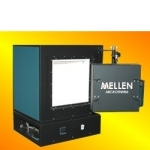
Muffle furnaces provide an enclosed heated chamber for laboratory processes requiring elevated temperatures in a controlled environment. They are versatile instruments commonly suited to heat treatment, ignition testing, materials research, loss-on-ignition procedures, ceramics work, sample preparation, gravimetric analysis, and other high-temperature laboratory applications.
Unlike a tube furnace, a muffle furnace provides a box-style chamber into which samples, crucibles, trays, and other appropriate laboratory ware can be loaded directly. This straightforward configuration makes muffle furnaces particularly useful for laboratories performing varied thermal-processing procedures rather than a single specialized experiment.
Mellen's history makes this category especially relevant to the brand. The company was founded around the idea of creating high-temperature furnaces capable of reducing uncontrolled temperature variations while making laboratory work more productive. Its modern furnace designs build on decades of research with computer-aided engineering and quality-control processes.
Selecting the right muffle furnace means looking beyond maximum temperature. Laboratories should also consider chamber dimensions, usable capacity, sample size, temperature uniformity, heating requirements, controller capabilities, recovery time, electrical requirements, and the amount of material that needs to be processed during each cycle.
Hogentogler's Mellen lineup currently includes three different muffle furnace models, giving laboratories several options within this focused category.
Mellen doesn't treat high-temperature furnaces as a side business. Furnace design is quite literally what the company was built around. We like Mellen muffle furnaces for laboratories that want a dedicated high-temperature instrument backed by decades of specialized thermal-processing experience. The American-made construction is another welcome distinction for facilities that prioritize domestically manufactured laboratory equipment.
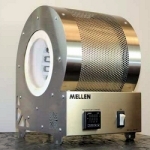
Tube furnaces replace the conventional box-style chamber with a cylindrical heated zone surrounding a process tube. That seemingly simple change in geometry creates a remarkably flexible platform for laboratory research, particularly when scientists need greater control over the environment surrounding a sample.
Depending on the complete system configuration, tube furnaces can be useful for processes involving controlled atmospheres, gas flow, thermal treatment, materials synthesis, annealing, calcination, sintering, catalyst research, ceramics, metallurgy, and other experimental procedures. They are widely applicable to materials science, chemistry, engineering, semiconductor research, and academic R&D environments.
For researchers, one of the defining advantages of the Mellen tube furnace format is the ability to build the heating system around the experiment. The process tube, heated-zone length, tube diameter, temperature requirements, atmosphere, gas-handling arrangement, sample dimensions, and controller configuration can all become important parts of the selection process.
That makes choosing a tube furnace somewhat different from selecting a general-purpose chamber furnace. A model's maximum temperature alone tells only part of the story. Researchers should consider how much of the tube needs to be heated, the required uniform working zone, what material will be processed, whether gases need to pass through the system, and how samples will enter and exit the heated area.
Mellen offers considerably more breadth here than in its muffle furnace category. Hogentogler's Mellen brand page lists 33 different tube furnace models, compared with three muffle furnace models. That depth makes tube furnaces the centerpiece of the Mellen lineup available through Hogentogler.
This is where Mellen's specialization really gets to stretch its legs. Tube furnace applications can range from relatively straightforward heating procedures to highly controlled research processes, and having a broad selection matters when tube size, heated length, temperature, and experimental setup all come into play. With 33 models represented on Hogentogler's Mellen page, researchers have considerably more room to match the furnace to the experiment instead of making the experiment accommodate the furnace.
The Mellen equipment organized on Hogentogler's brand page falls into two categories: muffle furnaces and tube furnaces. The current page lists three different muffle furnace models and 33 different tube furnace models.
A muffle furnace uses an enclosed chamber into which samples and laboratory ware can be placed directly. A tube furnace heats a process tube running through the furnace's heated zone. Tube furnaces are especially useful when the experimental setup calls for gas flow or greater control over the atmosphere surrounding a sample.
Muffle furnaces are suitable for a broad range of high-temperature laboratory procedures, including heat treatment, materials testing and research, ignition procedures, ceramics work, gravimetric analysis, sample preparation, and loss-on-ignition applications. The appropriate furnace ultimately depends on the required temperature, chamber size, sample load, and test method.
Tube furnaces can be used for applications such as heat treatment, annealing, calcination, sintering, materials synthesis, catalyst research, ceramics, metallurgy, and other high-temperature research processes. Their tubular design makes them particularly useful when an experiment requires a controlled sample environment.
Choose based on the process rather than temperature alone. A conventional muffle furnace is often the more practical choice when samples simply need to be heated within an enclosed chamber. A tube furnace becomes attractive when sample geometry, gas flow, atmosphere control, or the experimental setup calls for a cylindrical processing area.
Consider the required operating temperature, sample dimensions, chamber or tube size, heated-zone requirements, temperature uniformity, throughput, controller requirements, atmosphere requirements, electrical service, and the specific laboratory procedure being performed. For tube furnaces, tube diameter and heated length can be especially important selection criteria.
Yes. Mellen states that all of its products are made in the U.S.A.
Mellen has a wonderfully straightforward origin story for a furnace manufacturer: the company was founded because its founder thought high-temperature furnaces could be better.
Founded in 1966, Mellen grew from an effort to create furnaces that maximized productive work time while minimizing uncontrolled temperature variations. The company says its modern approach combines years of research with computer-aided design and stringent quality control, with all products manufactured in the United States.
That specialization is reflected in the Mellen selection available through Hogentogler. There aren't a dozen unrelated laboratory-equipment categories competing for attention. Instead, the lineup concentrates on two fundamental approaches to high-temperature laboratory processing: enclosed-chamber muffle furnaces and highly configurable tube furnaces.
For quality-control laboratories, universities, materials researchers, industrial R&D facilities, ceramics laboratories, engineering departments, and other organizations routinely working at elevated temperatures, that focus is valuable. Mellen isn't simply another laboratory-equipment brand that happens to manufacture furnaces. High-temperature furnace engineering has been the company's reason for being since 1966.